
Student Learning Assessment Tool Terminology
Assessment tools can generally be placed in two categories, direct and indirect measures.
Direct assessments allow for the evaluation of student work in light of the learning outcomes and have a clear relationship to a given outcome. Examples include:
- Rubric scores on projects, presentations, written work, or other assignments
- Specialized tests of knowledge or skill-based/lab-based performance
- Quiz or test scores
- Results of student performance observations
Indirect assessments are not based directly on student academic work but rather on the perceptions of
students, alumni, employers, and other outside agents. Examples include:
- Scores on external exams for entry into programs
- Interviews or focus groups
- Satisfaction surveys or course evaluation surveys
While both direct and indirect assessments form an important holistic impression of student experience, it is most useful for programs to start with the direct measures, given that it is there that student achievement is directly evaluated.
Classroom related assessment should be both formative and summative, and multiple measures should be built into an assessment plan or class.
Diagnostic assessments are used to determine student understanding and misconceptions before your course or unit begin in order to determine on which topics to focus more or less time.
Formative assessments are generally low stakes and monitor student learning to identify misconceptions, struggles, and learning gaps along the way. They can be used to to close those gaps, provide ongoing feedback to students, and can be used by instructors to improve their teaching. Examples include:
- Ask students to write one or two sentences identifying the main point of a lecture
- Ask students to turn in a research proposal for early feedback
Summative assessments are high stakes and help evaluate student learning at the end of an instructional unit by comparing it against some standard or benchmark. Examples include:
- A midterm exam
- A final project, paper, or capstone
Because summative assessments are usually higher-stakes than formative assessments, it is especially important to ensure that the assessment aligns with the goals and expected outcomes of the instruction.
Assessment Tools
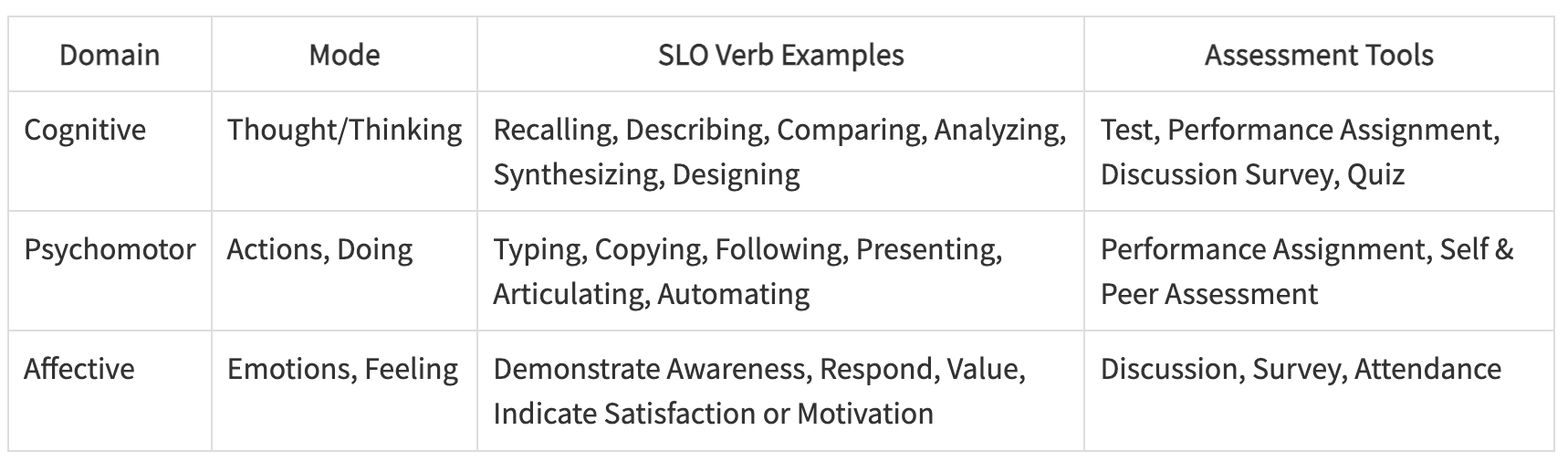
There are many categories of learning, each of which fall under three major domains: cognitive, affective, and psychomotor. See the chart below to see how assessment tools match learning domains.
Performance Assessments: These tools focus on students' tasks or products/artifacts of those tasks. They can simulate real life application of skills and can support learning and assessment in authentic contexts.
Pros: Can align well with learning outcomes; capture higher-order thinking skills; can reflect authentic contexts
Cons: Results may be difficult to generalize; take time to create, administer, and score
Tests/Quizzes: These tools are primarily presented in multiple choice format and strive for objectivity.
Pros: Collects quantitative data quickly; can be validated and highly reliable; can be used to compare groups of students or as pre-post ; can be locally developed, graded, and scored OR can reduce staff time on task if not locally developed
Cons: Can be standards focused as opposed to authentically assessing student abilities or performance; may oversimplify tasks at hand; maybe difficult to construct and interpret if developed locally
Self Reporting: These tools (including surveys, focus groups, and interviews) can ask students to estimate their learning or identify how they feel about their learning experiences.
Pros: Capture student perceptions